
At the deepest levels of reality, beyond the flesh, beyond the stars, exist a set of eternal creative principles that we represent as symbols.
The symbols we are most familiar with are letters and numbers. We call them into action by spelling - casting a spell - a word - a sequence of symbols expressed with emotion and intent to cause changes in the world around us.
It is said in Qabbalistic philosophy that numbers, letters and sounds are all one and the same in the Divine mind.
A word is a symbol or combination of symbols that can be expressed into The Air as sound, however its existence does not cease when the sound goes quiet.
The word exists outside of time, in hieroglyphic form as a supporting pillar of reality, and the sound that we hear is but a temporary resonance, an echo of its eternal quality.
When we write or sound words we are calling on their power, drawing it from the spiritual domain and expressing it into the physical.
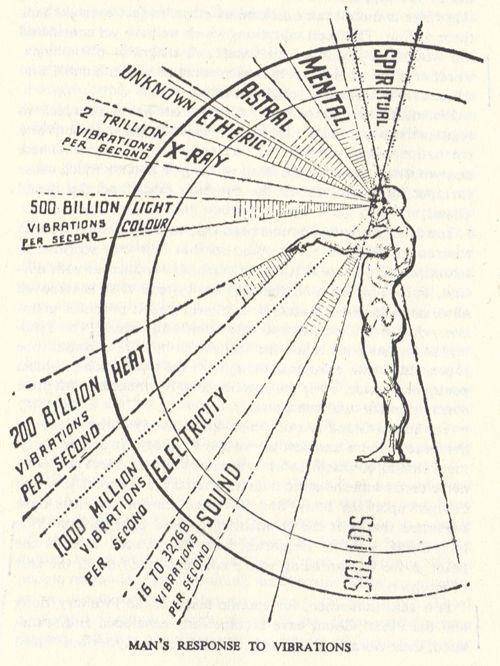
Image by Walter Russel
"I don't believe that the world is made of quarks or electromagnetic waves, or stars, or planets, or any of these things. I believe the world is
made of language." ~ Terrence McKenna
Many years ago I reached the same conclusion as Terrence here, even though I was thoroughly indoctrinated with theoretical physics, it became clear to me after further study that these objects physicists claim make up reality are in fact entirely ... theoretical (truth in plain sight), they are made of language - numbers and symbols - and they only exist in the minds of men.
This is where the distinction between science and scientism must be made.
Science is a verb, something that we do, it is a method of understanding the world through repeated observation and experiment. It's not something new or revolutionary, it is the proper use of our senses and brain to analyse and interpret the world. It's not a religion.
You don't have to wear a lab coat and deny creation to do science.
Scientism is the belief system that rejects creation and all the wisdom of ancient religions, and replaces that void with a cherry picked set of man-made "laws", theories and hypotheses.
Furthermore, it is the unquestioning belief in popularised theories and claims, and it is commonly held by people who know nothing about science at all but just accept the reality presented by the school system and media.
As someone who spent 8 years immersed in it, I can tell you from knowledge and experience, theoretical physics objectifies vibrational reality, turning waves into particles, dreaming up objects to explain phenomena that are purely vibrational in nature, even going so far as to spend countless billions chasing the hypothetical "God particle".
Now I'm no church militant, but is there anything more blasphemous than reducing the almighty God, creator of all and everything, to an infinitesimally small hypothetical object that doesn't even exist?
Of course not, the "God particle" is just an inversion of the idea of God.
But this was the goal of scientism all along, to objectify and eliminate the divine, and exalt the mighty scientist to the position of most high in the universe. It has nothing to do with the scientific method, which is a common practice for all civilised people.
"The public has a distorted view of science because children are taught in school that science is a collection of firmly established truths. In fact, science is not a collection of truths. It is a continuing exploration of mysteries." ~ Freeman Dyson
Many ancient scriptures reveal that the universe began as sound.
The New Testament of the Bible begins with the phrase “In the beginning was the Word”.
In the ancient Indian tradition the sound Aum is considered to be the creative source of the universe, and is chanted and symbolised all over the world with great reverence.
The word Universe comes from the Latin roots /unus/uni meaning “all” or “one” (All is One), and /versus/ meaning “a line of a song, rhyme or poem”. One song. One verse. One chapter of a bigger story?
Even the Big Bang theory, in all its clunky materialism, must submit to the primacy of sound. What is a "bang" if not a sound?
A bang is a sound, but it is without form, intent, musicality or meaning. It has no mind or intelligence behind it, it is not a word or a song or a declaration, in fact bang’s are generally considered to be unpleasant, short and loud and the result of mechanical failures, random, or accidental actions.
But the real reason the Big Bang theory was so popular is that it places scientists above everything else in the universe, it makes them the highest form of intelligence, dismissing the mystery of creation as mere random collisions of rocks and billions of years of chance happenstance.
Nevertheless, mysticism and scientism at least agree that the universe began as sound, and now that orderly cycles and rhythmic patterns are evidently commonplace within it, it logically follows that it is a musical system.
The universe displays abundant evidence of geometric, rhythmic, harmonic and melodic proportions, sequences of patterns, continuous change and partial unpredictability, all necessary qualities of music.
Music reflects life, and life reflects music.
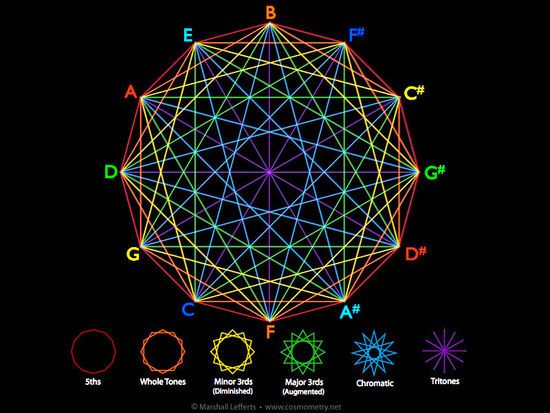
In the Greek mystery schools, Pythagoras taught that mathematics, music and astrology were the foundational triangle of all forms of higher thought.
He reasoned that music could not exist without mathematics, from which it depended upon the immutable proportions of harmony, and astrology could not exist without both music and mathematics, since it is the "music of the spheres".
We will dive into the musical science of astrology in future posts, but this knowledge later became known as the Quadrivium (arithmetic, geometry, music and astronomy) which together with the Trivium (grammar, logic and rhetoric) formed the so-called 7 Liberal Arts of the western education tradition.
It is sometimes mistakenly believed that Pythagoras invented music, this is not true, the practice extends deep into antiquity and is found in all groups of humans so far observed, but he was the first to demonstrate and write down the mathematical framework of music, raising it from an instinctive practice based on individual taste, feeling and style, to a noble art and science of harmonics.